
English
Views: 0 Author: Site Editor Publish Time: 2026-06-30 Origin: Site


Marine environments expose crews to high-risk chemicals like industrial solvents, heavy fuels, and aggressive cleaning agents. Crews operate in isolated, highly corrosive, and constantly moving conditions. These extreme hazards make immediate decontamination absolutely critical for saving eyesight during emergencies. Unfortunately, standard industrial safety equipment often degrades rapidly or fails to function correctly at sea. Relentless saltwater spray, intense UV exposure, and continuous vessel vibration quickly compromise typical onshore systems. You simply cannot rely on fragile plastics or rust-prone metals when navigating offshore hazards. Selecting the right portable emergency eyewash for marine use requires balancing strict ANSI compliance with the harsh physical realities of offshore application. This guide breaks down the technical criteria, compliance standards, and maintenance realities. You will learn how to evaluate durability, assess vessel infrastructure, and verify supplier credentials.
Infrastructure dictates choice: Portable units are the necessary default for isolated decks, engine rooms, and offshore platforms lacking reliable, climate-controlled plumbing.
Material survival is non-negotiable: High-Density Polyethylene (HDPE) and marine-grade stainless steel are mandatory to resist saltwater corrosion and UV degradation.
Compliance is measurable: An ANSI Z358.1 portable eyewash station must deliver 0.4 gallons per minute (GPM) for a continuous 15 minutes, regardless of vessel pitch or roll.
Maintenance limits risk: True cost of ownership includes the rigorous scheduling of bacteriostatic preservatives and fluid replacements.
Saltwater and airborne corrosives destroy standard safety equipment at an alarming rate. Ordinary plastics become brittle within months of offshore exposure. Lower-grade metals rust quickly in the salty, humid air. This accelerated degradation leads to catastrophic mechanical failure during emergencies. You might pull an activation handle only to have it snap off. Marine environments demand materials specifically engineered to resist galvanic corrosion and continuous salt spray.
Pitch, roll, and heavy engine vibration create constant physical stress. These forces can easily dislodge poorly secured wall-mounted units. Standard tank seams often develop micro-fractures due to continuous shaking. When you mount a tank on a bulkhead, it absorbs the kinetic energy of the vessel. We regularly see standard industrial units crack under these dynamic loads. Heavy-duty construction and specialized mounting systems are mandatory for survival.
Temperature extremes pose another significant hurdle. Exposed decks face freezing temperatures in arctic routes. They endure intense heat during equatorial transits. It becomes incredibly difficult to maintain required "tepid" water temperatures. Tepid water prevents shock and secondary eye injury. You cannot achieve this baseline safety requirement without specialized insulation or active heating jackets. Freezing lines or boiling tank water render standard units useless.
Water supply isolation complicates emergency response further. Deep-hull engine rooms often lack immediate access to potable water lines. Far-aft decks frequently suffer from the same infrastructure gap. Safety regulations require an eyewash station within a 10-second walk of a hazard. You cannot rely on distant plumbed fixtures when seconds count. This isolation necessitates a fully self-contained solution tailored for remote deployment.
Plumbed systems work best in highly controlled spaces. They are ideal for galleys, medical bays, or climate-controlled engineering control rooms. These units require reliable potable water and consistent pressure. However, they carry significant constraints. Exposed pipes freeze on open decks. Installing them requires extensive retrofitting and costly pipe runs. You cannot easily relocate them if you shift chemical storage areas.
A portable emergency eyewash easily bypasses these strict plumbing constraints. It allows immediate deployment at the exact site of chemical hazards. You can place them near chemical storage lockers. You can mount them next to engine maintenance bays. They offer unmatched mobility and immediate readiness. When your operational layout changes, you simply move the unit to the new hazard zone.
Deciding between the two relies on a straightforward matrix. First, identify your chemical hazard zones. Then, measure the travel time to the nearest reliable water source. If the hazard zone sits more than a 10-second unobstructed walk away, action is required. Furthermore, if that water source lacks climate control, it poses a risk. In these scenarios, a portable unit becomes the required operational safeguard.
The chart below outlines how infrastructure constraints directly influence equipment selection across different onboard zones.
Installation Zone | Primary Challenge | Recommended Solution | Reasoning |
|---|---|---|---|
Open Decks | Freezing temperatures, zero plumbing | Portable Unit with Heated Jacket | Bypasses pipe freezing risks; self-contained. |
Engine Rooms | High vibration, isolated layout | Heavy-Duty Portable Unit | Immediate access near fuel/solvent hazards. |
Medical Bays | None (Climate controlled) | Plumbed System | Reliable potable water and pressure exist here. |
Chemical Lockers | Mobile hazards, tight spaces | Compact Portable Unit | Ensures the 10-second access rule is met. |
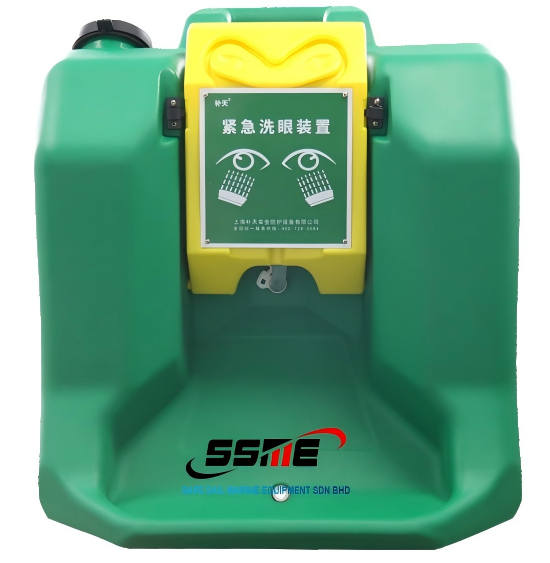
Material durability forms the foundation of any marine-grade equipment. The ocean easily destroys substandard materials. Look for UV-stabilized, high-impact High-Density Polyethylene (HDPE). Alternatively, specify 316-grade stainless steel for maximum corrosion resistance. Avoid any components featuring exposed mild steel springs. Unprotected brass valves will corrode and seize. You must scrutinize every fastener and valve material.
Volume and flow delivery directly impact compliance and safety. The system must hold a minimum of 14 to 16 gallons of usable fluid. This volume ensures it can deliver the required 15-minute flush. Gravity-fed systems demand careful design. They must feature enclosed reservoirs to prevent sloshing. Vessel movement easily causes evaporation and spillage if the tank lacks a proper seal.
Mounting and stability profiles require special attention aboard a ship. Standard wall screws will fail under heavy seas. You must use heavy-duty, marine-specific mounting brackets. We recommend robust J-hooks or securely strapped cradles. These brackets must withstand high-seas vibration without dislodging. A loose 16-gallon tank becomes a dangerous projectile during a storm.
Activation mechanisms must be incredibly simple and foolproof. In an emergency, the victim is usually temporarily blinded and panicked.
It must feature a single-motion pull-strap or push-handle.
The mechanism must operate smoothly without complex latches.
It must accommodate users wearing heavy neoprene maritime gloves.
The activation must lock open automatically to allow hands-free flushing.
The 15-minute rule serves as the absolute baseline for compliance. An ANSI Z358.1 portable eyewash station must sustain a minimum flow of 0.4 GPM. It must maintain this flow continuously for exactly 15 minutes. You must perform a critical assumption check regarding tank capacity. Always verify that the "total capacity" accounts for the dead space at the tank bottom. Water sitting below the output valve cannot flush eyes.
The tepid water mandate proves especially challenging at sea. ANSI strictly requires flushing fluid temperatures to remain between 60°F and 100°F (16°C - 38°C). Extreme weather routes complicate this implementation reality. For arctic routes, you must pair units with reliable freeze-protection, like heated blankets. For equatorial routes, reflective insulation or shaded mounting is mandatory. You must prevent the sun from heating the water and scalding the user.
Spray pattern and force also fall under strict regulatory guidelines. High-pressure jets can drive chemicals deeper into the ocular cavity. The wash heads must flush both eyes simultaneously. The flow velocity must remain low enough to avoid causing further injury. Gravity-fed units excel here, as they naturally regulate pressure. They provide a soft, continuous ribbon of water perfectly suited for delicate eye tissues.
The stagnation risk presents a hidden danger for stored water systems. Stored water in a marine environment quickly becomes a breeding ground for dangerous pathogens. Acanthamoeba and Legionella thrive in warm, stagnant tanks. Flushing an injured eye with contaminated water can cause permanent blindness. You must actively manage water quality to ensure the cure is not worse than the hazard.
Bacteriostatic additives offer the most practical solution for remote deployments. Procurement teams must factor in the supply chain logistics for these water preservatives. Standard potable water spoils in just a few days. Adding a proper preservative extends the safe fluid life to three or six months. You must secure a reliable global supply of these additives to maintain operational readiness across all vessels.
Strict inspection protocols form the backbone of a successful safety program. HSE managers must enforce mandatory weekly visual inspections. Staff must check the nozzles for dust or debris blockages. They must verify mounting bracket integrity and check internal fluid levels. You must document these inspections meticulously. Furthermore, you must strictly adhere to the scheduled fluid replacement cycles dictated by your preservative.
Training transforms theoretical safety into practical survival. Crew drills must simulate real-world conditions. You should require crew members to navigate to the eyewash station blindfolded. This drill verifies the 10-second access rule holds true within your specific vessel layout. If a crew member trips over a bulkhead lip during a blind drill, you must relocate the station immediately.
Partnering with a reliable manufacturer ensures you receive compliant, durable equipment. Sourcing specialized marine gear demands strict vetting procedures.
Certification Transparency: A credible marine eyewash station supplier should provide official third-party testing certificates. These documents must prove full ANSI Z358.1 compliance. Never accept internal marketing claims without independent laboratory verification.
Global Parts Availability: Ships constantly move across the globe. Your supplier must ship replacement parts to international ports seamlessly. You will eventually need new pull-straps, replacement spray heads, and fresh water preservatives. A supplier limited to domestic shipping cannot support an international fleet.
Warranty in Harsh Conditions: You must scrutinize the fine print of the warranty. Many industrial suppliers automatically void standard warranties if equipment faces "saltwater environments." Ensure your contract explicitly covers marine, offshore, or high-salinity deployments.
Sourcing emergency eyewash equipment for marine use is never a standard catalog purchase. It demands careful alignment of material durability with specific vessel layout constraints. You must maintain strict ANSI compliance despite extreme weather and constant motion. Standard plastics and weak metals will fail when your crew needs them most. Proper selection saves eyesight and ensures continuous operational safety.
Take immediate action to secure your offshore operations. Conduct a comprehensive HSE audit of all vessel hazard zones, including chemical storage and engine spaces. Verify that the 10-second travel rule applies effectively everywhere. Finally, shortlist suppliers specializing in offshore environments. Request their detailed specification sheets to confirm UV stabilization and high-grade corrosion resistance.
A: If you use plain potable water, you must change it weekly. If you utilize an approved bacteriostatic preservative, the cycle extends significantly. Preserved water typically lasts between three to six months. Always base the exact schedule on the manufacturer’s specific guidelines and the ambient temperature of your operational route.
A: No. Chemical automotive antifreeze will cause severe, irreversible eye damage. You must never introduce toxic chemicals into an eye-flushing system. Instead, you must use manufacturer-approved heated jackets or specifically insulated cabinets. These solutions safely maintain tepid water temperatures in freezing marine conditions.
A: US-based OSHA jurisdiction may legally end at specific maritime boundaries. However, ANSI Z358.1 serves as the globally recognized, definitive best-practice standard. Adhering to it protects your crews universally. It also mitigates severe corporate liability regardless of the vessel's exact geographical location.


