
English
Views: 0 Author: Site Editor Publish Time: 2026-09-22 Origin: Site


Marine firefighting presents an unforgiving operational reality. Fires frequently ignite in confined, steel-enclosed spaces containing high concentrations of Class B hazards. Fuels, heavy oils, and lubricants dominate these environments. These volatile conditions demand immediate, mobile suppression long before fixed systems can be safely deployed. A tactical gap exists between standard handheld units and fixed suppression systems. Handhelds lack sustained discharge capacity. Fixed systems require complete compartment evacuation and total engine shutdown. Vessel operators must balance rapid response capabilities with crew safety. Firefighters enter toxic, smoke-filled environments to neutralize threats before flames spread. Unchecked fires quickly compromise a vessel's structural integrity. The backpack foam fire extinguisher serves as a specialized tactical asset designed to bridge this exact gap. It offers extended suppression capacity and hands-free mobility through narrow bulkheads while maintaining compatibility with respiratory protection gear.
Targeted Deployment: Backpack foam units are primarily deployed for rapid intervention in engine rooms, machinery spaces, and helidecks where Class B spill fires require immediate vapor sealing to prevent re-ignition.
Mobility vs. Capacity: These systems provide significantly higher volume than a standard portable foam fire extinguisher while maintaining the mobility required to navigate steep ship ladders and tight corridors.
Respiratory Integration: Effective deployment in marine environments often requires an integrated air respirator foam extinguisher setup or seamless compatibility with a standard self contained breathing apparatus (SCBA) due to rapid oxygen depletion.
Procurement Strategy: Sourcing from a certified marine firefighting equipment supplier is critical to ensure compliance with SOLAS (Safety of Life at Sea) and IMO (International Maritime Organization) regulations.
Early intervention dictates the outcome of any maritime fire incident. The first few minutes determine whether a localized spill becomes a catastrophic event. Having a high-capacity, mobile unit allows emergency crews to respond immediately. This rapid action can extinguish a localized fuel spill before it escalates. A vessel-wide fire threatens the lives of the crew and the survival of the ship itself. First responders need equipment that matches the intensity of the threat. Delaying suppression while waiting for fixed CO2 or water mist systems to activate often results in severe structural damage. The heat generated by a heavy fuel oil fire in an enclosed steel compartment can warp bulkheads and destroy adjacent electrical routing within minutes.
Standard 9-liter units routinely fail during machinery space fires. They simply lack the required foam volume to tackle large spill fires effectively. A typical 9-liter portable foam fire extinguisher discharges completely in under thirty seconds. This short duration provides insufficient coverage for expanding fuel fires. Crews are forced to carry multiple units to the scene. This ties up valuable hands and slows down the response time. Navigating vertical Jacob's ladders or steep companionways while carrying heavy metal cylinders creates severe safety hazards for the crew. Dropping a cylinder in a smoke-filled environment leaves the firefighter defenseless against the advancing flame front.
Wheeled extinguishers offer excellent capacity but fail entirely in mobility. Maneuvering 50-liter wheeled units is physically impossible in many ship sectors. Watertight doors feature raised coamings that block wheels. Steep companionways and narrow corridors prevent the passage of bulky carts. Grating decks in engine rooms trap small wheels instantly. Firefighters waste critical minutes attempting to drag wheeled units over these obstacles. The physical layout of a commercial vessel renders wheeled units useless for rapid interior attacks. They remain relegated to flat, open deck spaces where their mobility is not hindered by the ship's structural architecture.
The backpack system fills a highly specific tactical void. It delivers 15 to 25 liters of foam concentrate directly to the seat of the fire. A single operator carries this payload while keeping both hands free. This hands-free capability allows the firefighter to navigate complex vessel architecture safely. Opening heavy watertight hatches and climbing vertical ladders remains possible. The operator arrives at the fire scene with enough suppression agent to make a definitive impact. This capacity bridges the gap between inadequate handhelds and immobile wheeled units. It provides the exact balance of firepower and agility required for interior marine firefighting.
Extinguisher Class | Agent Capacity | Discharge Time | Mobility Rating | Primary Marine Application |
|---|---|---|---|---|
Standard Handheld | 9 Liters | 20 - 30 Seconds | Moderate (Requires one hand) | Accommodation spaces, galleys, small incipient fires. |
Backpack Unit | 15 - 25 Liters | 60 - 180 Seconds | High (Hands-free navigation) | Engine rooms, purifier rooms, confined machinery spaces. |
Wheeled Cart | 50 - 100 Liters | 3 - 5 Minutes | Low (Blocked by coamings) | Main deck, cargo manifolds, ro-ro vehicle decks. |
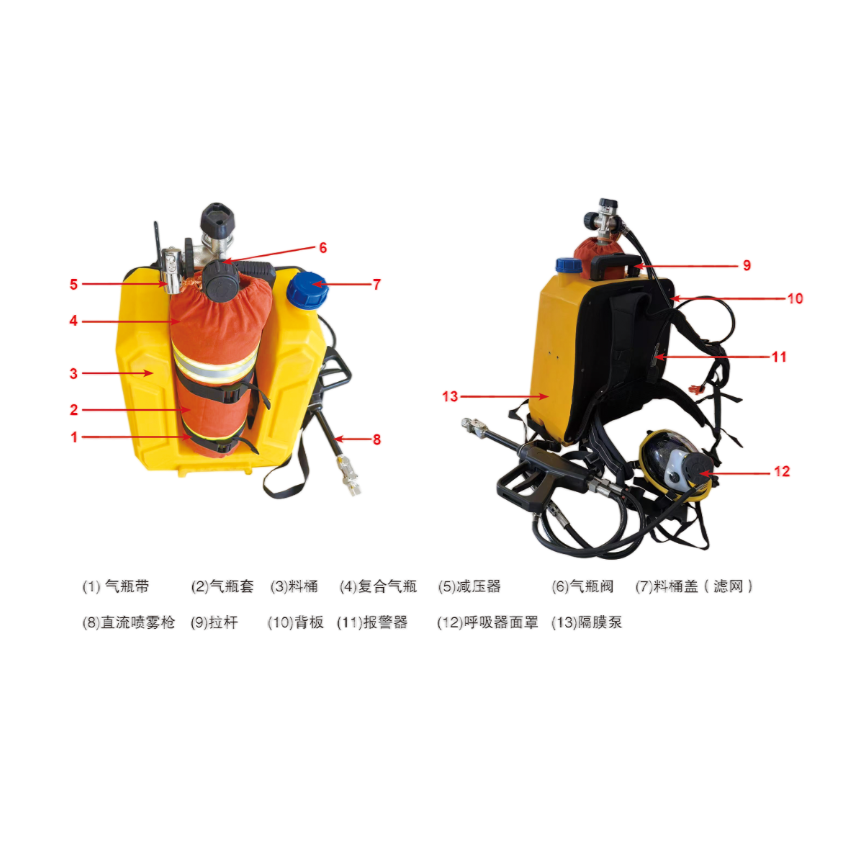
Engine rooms house the highest concentration of fire risks on any vessel. Bilge fires, ruptured high-pressure fuel lines, and generator enclosures present massive hazards. The fuel oil purifier room is particularly dangerous. Centrifugal separators spin heavy fuel oil at high temperatures. A mechanical failure here creates a pressurized spray fire that coats the entire compartment in burning oil. Foam creates a thick, physical blanket over these dangerous areas. It rapidly cools the burning fuel surface. More importantly, it suppresses flammable vapors rising from the liquid. This action prevents re-ignition inside high-heat steel compartments. Steel bulkheads retain immense heat, easily re-igniting exposed fuel if the vapor seal breaks. Backpack units allow operators to spray foam continuously while moving around large diesel engines and navigating the narrow walkways between auxiliary generators.
Offshore platforms and vessels equipped with aviation facilities face unique fire risks. Helicopter refueling operations require immediate, high-volume foam application capabilities. Localized deck spills involving aviation fuel demand rapid containment. Wind conditions on open decks complicate fire suppression efforts. Fixed foam monitors may not cover blind spots behind the aircraft. Backpack units allow operators to approach the fire from upwind. The operator can adjust their position dynamically as wind directions shift. This mobility ensures the foam blanket covers the spill accurately, securing the helideck for safe evacuation or continued operations. The operator can walk directly to the edge of the spill, applying a gentle foam blanket without relying on the long-range trajectory of a fixed monitor.
Complex rescue operations often prevent the activation of total-flooding fixed systems. Trapped personnel would be immediately endangered by CO2 or inert gas discharges. Rescuers must suppress flames locally to extract casualties safely. Double bottom tanks, pump rooms, and duct keels represent highly restricted environments. Dragging a charged 1.5-inch fire hose through a 600mm manhole is physically impossible. Backpack systems allow targeted suppression while keeping rescuers highly mobile. The operator can lay down a protective foam path. This path shields both the rescuer and the casualty from radiant heat. The ability to carry substantial firefighting power into a confined space without dragging hoses saves lives during critical extractions.
Marine-grade foam concentrates are mandatory for successful suppression. Formulations must remain highly stable in harsh maritime climates. They must also handle seawater induction without losing their chemical integrity. The foam creates an impermeable seal directly over flammable liquids. It actively suffocates the fire by cutting off the oxygen supply. Simultaneously, it stops combustible vapors from escaping the fuel surface. This dual-action mechanism guarantees the prevention of re-ignition. Low expansion ratios knock down active fires quickly by penetrating thermal updrafts. Medium expansion ratios provide superior vapor suppression efficacy over large spill areas.
The transition to fluorine-free foam (F3) has changed operational tactics. Legacy Aqueous Film-Forming Foams (AFFF) relied on a chemical film to seal vapors. Modern F3 foams rely entirely on the physical bubble blanket. This requires the operator to apply a thicker layer of foam to achieve the same vapor security. Backpack units provide the necessary volume to build this thicker blanket. Operators must understand the specific expansion characteristics of the foam loaded in their units to ensure they apply enough agent to secure the hazard zone permanently.
Harness design dictates operational success in tight quarters. Weight distribution and center of gravity directly impact firefighter agility. The physical footprint of the backpack determines how an operator moves. Standard marine hatches and watertight doors pose severe snag hazards. Bulky equipment catches on latches and door frames, halting forward progress. Proper ergonomic design keeps the equipment profile tight against the operator's body. Padded shoulder straps and adjustable waist belts transfer weight to the hips. This reduces strain on the shoulders and allows for smoother navigation through restricted bulkheads. A low center of gravity prevents the operator from losing balance when the vessel pitches and rolls in heavy seas.
Respiratory protection is an absolute requirement in marine firefighting. Toxic smoke and rapid oxygen depletion kill faster than flames. Wearing a standalone backpack extinguisher over an existing self contained breathing apparatus creates severe structural challenges. Harnesses overlap, restrict movement, and create dangerous pressure points. The combined weight pulls the operator backward, creating a severe fall hazard on wet steel decks.
Utilizing an integrated air respirator foam extinguisher solves this critical issue. Breathing air cylinders and suppression agent tanks are engineered into a single, streamlined harness system. This unified approach eliminates snag hazards and drastically improves operator comfort during extended fire attacks. The operator dons one piece of equipment, connects their face mask, and immediately deploys to the fire scene. This integration shaves valuable minutes off the response time.
A fully loaded backpack unit weighs upwards of 25 to 35 kilograms. The liquid agent, pressurized cylinder, and heavy-duty harness add significant bulk. Crews face intense physical exhaustion during active firefighting operations. Heavy, insulated bunker gear compounds this fatigue rapidly. High ambient temperatures in engine rooms accelerate physical drain. Operators must constantly balance suppression capacity against human endurance limits. Safety officers must rotate crews frequently to prevent heat exhaustion. Selecting the right capacity unit requires understanding the physical capabilities of the onboard response team. A 25-liter unit provides massive knockdown power but may exhaust a smaller crew member before they even reach the fire.
Specific tactical training is mandatory to operate backpack systems effectively. Improper foam application breaks the vapor seal and worsens the situation. Plunging the foam stream directly into burning oil splashes the fuel. This spreads the fire rapidly across the deck. Crews must learn to bank foam gently off a bulkhead or deck plate. Proper technique ensures the foam flows smoothly over the fuel surface. Regular drills must reinforce these application techniques. Muscle memory developed during training prevents catastrophic mistakes during the chaos of an actual engine room fire.
Approach the fire from upwind or the safest accessible doorway.
Aim the nozzle at a vertical surface adjacent to the burning liquid pool.
Discharge the foam, allowing it to run down the bulkhead and spread naturally over the fuel.
Sweep the nozzle slowly to build a continuous, unbroken blanket of foam.
Monitor the blanket for any breaks or bubbling, reapplying foam to secure the vapor seal.
Pressurized cylinders require strict, regular hydrostatic testing. Foam concentrates possess specific shelf-lives that cannot be ignored. Servicing these complex units at sea presents major logistical challenges. Ships lack the specialized equipment needed to recharge high-pressure air cylinders safely. Port-based maintenance schedules must align perfectly with vessel operations. Neglected maintenance leads to failed pressurization during emergencies. Engineers must track inspection dates meticulously. Keeping spare foam concentrate and replacement parts onboard mitigates the risk of equipment downtime during long voyages.
Component | Inspection Frequency | Action Required |
|---|---|---|
Harness and Webbing | Monthly | Check for fraying, chemical degradation, and buckle integrity. |
Pressure Gauges | Monthly | Verify cylinder pressure is within the green operational zone. |
Foam Concentrate | Annually | Test for sedimentation, viscosity changes, and expansion ratio. |
Air/Nitrogen Cylinders | Every 5 Years | Perform mandatory hydrostatic pressure testing at a certified shore facility. |
Regulatory compliance drives all equipment procurement in the maritime industry. Product specifications must map directly to IMO and SOLAS requirements. Supplementary marine fire safety equipment must meet strict international performance standards. Port state control inspectors verify these certifications during routine boardings. Non-compliant equipment results in vessel detentions and severe financial penalties. The Fire Safety Systems (FSS) Code outlines the exact specifications for portable and semi-portable extinguishing systems. Backpack units must carry the appropriate type approvals for the flag state of the vessel.
Scalability depends on several specific vessel characteristics. Gross tonnage, machinery space volume, and total crew size determine required unit quantities. A small tugboat may only require one unit near the engine room entrance. A massive crude oil tanker needs multiple units stationed across various deck levels. Safety officers must conduct a thorough risk assessment to map out deployment stations. Units should be placed outside high-risk zones, ensuring they remain accessible even if the primary hazard area is engulfed in flames.
Selecting a reliable marine firefighting equipment supplier requires strict evaluation criteria. Look for verified certifications and a robust global service network. Replacement part availability in major ports is non-negotiable. Access to compliant, fluorine-free marine firefighting foam concentrates is essential for future-proofing your inventory. High-quality marine foam fire extinguishing equipment represents a critical investment in crew survival. The supplier must provide detailed technical documentation, including material safety data sheets (MSDS) for the foam and operational manuals for the harness systems.
The backpack foam unit does not replace fixed suppression systems or basic handheld extinguishers. It operates as a specialized rapid-response tool essential for high-risk Class B environments. Vessels with large, complex machinery spaces benefit immensely from this technology. Offshore platforms and ships handling hazardous liquid cargo require this immediate vapor suppression capability. Equipping your crew with the right tactical tools prevents minor spills from becoming major maritime disasters.
Conduct a physical hazard assessment of vessel bulkheads and hatch dimensions to ensure backpack clearance.
Consult a certified supplier to evaluate SCBA-compatible backpack models for your specific crew size.
Plan a clear transition strategy for adopting environmentally compliant fluorine-free foam concentrates.
Schedule hands-on crew training focused specifically on bulkhead banking techniques and vapor sealing.
A: Backpack units offer significantly higher capacity than standard handhelds. They provide hands-free operation, allowing users to navigate steep ladders and tight hatches safely. This mobility advantage ensures a much faster emergency response compared to heavy wheeled units that cannot cross raised thresholds.
A: Wearing two separate harnesses creates overlapping straps and restricts movement. To solve this compatibility challenge, vessels often utilize an integrated air respirator foam extinguisher. This combined system mounts both the breathing air cylinder and the foam agent on a single ergonomic backplate designed for toxic environments.
A: These systems are engineered specifically for Class B fires involving flammable liquids. Common hazards include diesel, heavy fuel oil, and lubricants found in marine engine rooms. The foam works by suffocating the fire, cooling the surface, and sealing combustible vapors to prevent re-ignition.
A: Discharge times typically range from 1 to 3 minutes, depending on the tank capacity and nozzle flow rate. This duration emphasizes its role as a rapid-attack tool. It is designed to knock down localized spill fires and secure the area before flames spread out of control.
A: Backpack systems require strict annual inspections. The pressurized air or nitrogen cylinders must undergo hydrostatic testing every five years. Additionally, the foam concentrate must be tested or replaced according to the manufacturer's shelf-life guidelines and maritime regulatory schedules to ensure optimal expansion rates.
A: Prioritize suppliers that provide equipment with recognized marine approvals, such as MED/Wheelmark certifications. Ensure they offer global servicing capabilities so units can be maintained in various ports. Technical support for SCBA integration and access to compliant fluorine-free foams are also critical factors.


